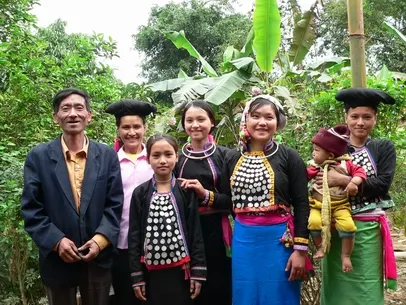
These very small groups are counted among Lai Châu's 20 and Điện Biên's 19 groups. Most live in the far west, around Mường Tè and Mường Nhé.
Dress
The Kháng and Cống dress like the Thái, though a few Cống families still keep sets of traditional Lao-woven clothes. Si La women wear a skirt tucked up at the back and a blouse fastened at the right whose front is covered in silver and aluminium coins. Unmarried girls wear a plain white headscarf, and married women an indigo-black one over hair tied on top of the head. La Hủ women's headscarves carry many coloured tassels and their blouses rows of coins. Children's caps are sewn with silver coins and are believed to hold the child's soul, so they are never sold or given away. Mảng women wear a wrap of rough white cloth with a line of red embroidery, with their hair in a tasselled topknot and leggings.
Traditions and beliefs
Si La women's blouses are covered with silver and aluminium coins. The La Hủ are noted for their rattan trays and ironwork, and a La Hủ bride price must include squirrel meat. The Cống make rattan mats dyed red. The Kháng believe each person has five souls.