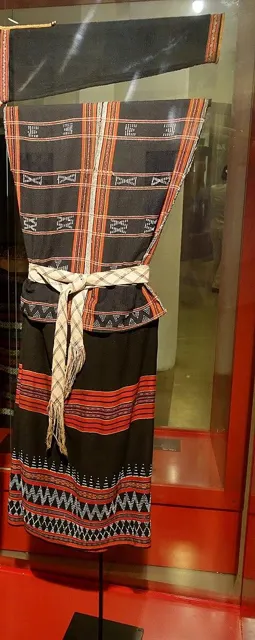
The group closest to home, in the hills west of Hội An and Đà Nẵng; about three-quarters of all Cơ Tu live in Quảng Nam. They are known for the tall carved gươl communal house at the centre of each village and for wood carving. Their most prized black cloth is patterned with lead and white beads.
Dress
Their cloth is woven on a black ground with patterns in lead and in white beads. Men wear a loincloth and often go bare-chested. Women wear a tube skirt: a long one covers them from the chest down, while with a short one they wear a sleeveless top, adding a plain white belt for festivals. Large woven cloths serve as wraps and blankets.
Traditions and beliefs
Offerings range from an egg or a chicken for small rites up to a buffalo, the greatest sacrifice. The village buffalo sacrifice and the reburial ceremony for the dead are the biggest events. New Year is held village by village in January or February, after threshing, though many now hold it at Tết. Women dance the dạ dạ and men the ting tung to gongs and drums. Marriage follows a one-way rule: if family A gives a daughter to family B, B may not give a daughter back to A.
Food and drink
Plain rice day to day, sticky rice at festivals, traditionally eaten with the hands. They keep buffalo, pigs, dogs and chickens but get most of their daily food from hunting and fishing. They like grilled food and meat cured in bamboo tubes, with sugar-cane wine and tà-vạk palm wine.