Setting
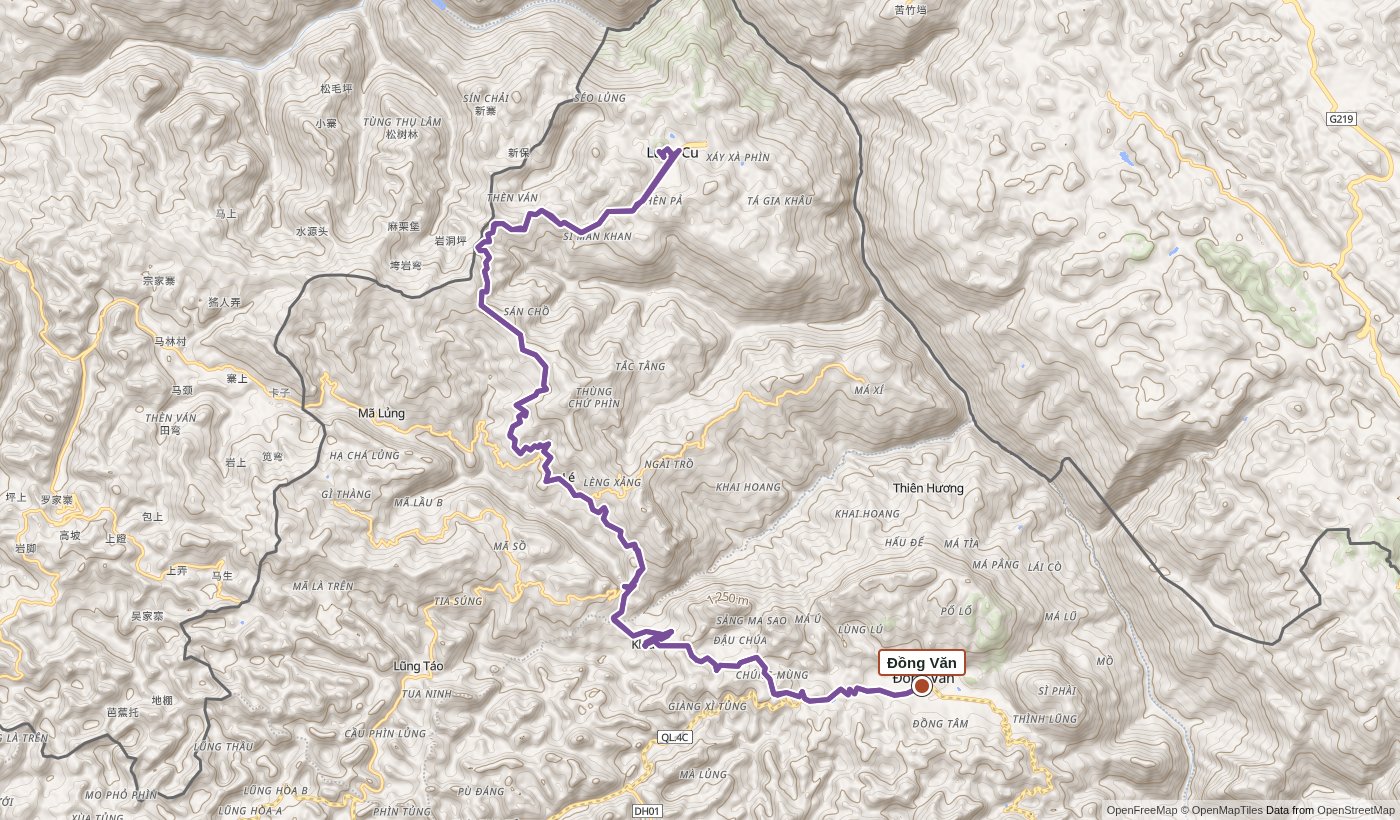
Lũng Cú is a short loop north to the tip of Vietnam. The flagpole stands on Dragon Mountain (Long Sơn) at about 1,470 m, above terraced valleys and Lô Lô villages.
Story
Tradition says Lý Thường Kiệt planted a flag here in the 11th century to mark the realm. Quang Trung later set up a guard post with a bronze drum. In 1887 France and the Qing considered ceding Lũng Cú, but it stayed Vietnamese. The present octagonal flagpole, more than 30 m high, was opened in 2010. On the way back, Phố Là is a Pu Péo village.
People
Lô Lô (Lũng Cú), Hmong, Pu Péo (Phố Là), Giáy and Hoa.
Population and livelihoods
Around Lũng Cú, families once lived from maize, buckwheat and a few animals. Since UN Tourism named Lô Lô Chải one of its Best Tourism Villages in October 2025, about 40 to 50 households, nearly half the village, have run homestays. Across Lũng Cú there are 62 recognised homestays, able to sleep about 1,000 guests a night. The plateau’s best-known product is mint honey (mật ong bạc hà), from the white mint that flowers in late autumn; Đồng Văn protects about 1,100 ha of it for some 15,800 hives.
What makes it special
You stand on the northernmost point of Vietnam. The Đồng Văn weekly market is one of the most authentic in the north, with Hmong, Lô Lô and Giáy coming in from the plateau.
The peoples in more detail
Along the way: Lô Lô (Lũng Cú), Hmong, Pu Péo (Phố Là), Giáy, Hoa.
Lô Lô (Yi)
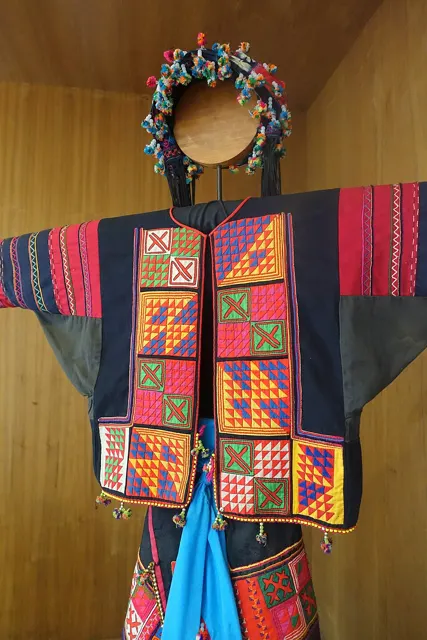
A small group whose costumes are made of large blocks of coloured patchwork and appliqué, with some beeswax-printed patterns. There are two branches, the Flower Lô Lô and the Black Lô Lô.
Food: Steamed maize flour is the staple, and every meal must include a soup, eaten from wooden bowls with wooden spoons.
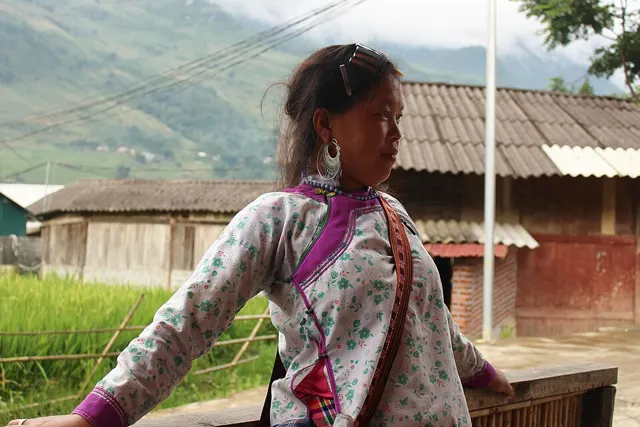
Dress: Lô Lô dress is known for patchwork in coloured cloth. Black Lô Lô women of Lũng Cú wear a square-necked pullover blouse with bands of birds around the body and wide sleeves made of rings of different colours, with a skirt, a long rectangle of cloth hanging behind the hip and leggings. Flower Lô Lô women, in Lũng Táo, Sủng Là and Mèo Vạc, cover the front and back of the tunic with small triangles of coloured cloth sewn into squares, often 12 to 20 triangles to a square. The motifs include the sun, birds, buffalo horns and the Ngó Bá bird of their religion. The headscarf is wound many times round the head.
Hmong (H'Mông, Mèo, old name, now avoided)
The people you'll see most in the high country. They make up about 72% of the Đồng Văn plateau and about half of Sa Pa, and Mường Lống is entirely Hmong.
Food: Two meals a day, three at harvest.
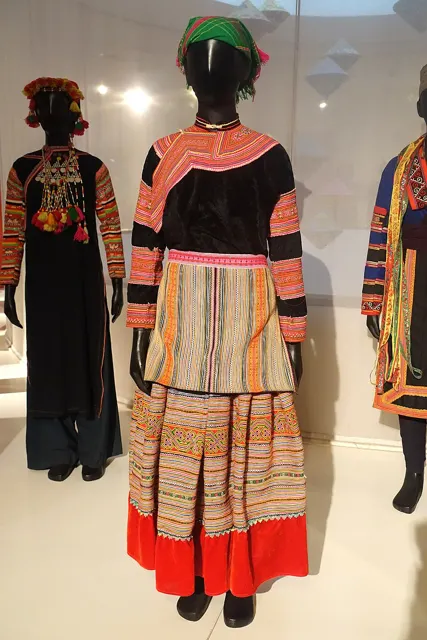
Dress: The most colourful dress in the north, and different for each branch. White Hmong women grow hemp and weave linen, and wear white skirts with an open-fronted blouse embroidered on the sleeves and a panel at the back of the collar. Flower Hmong women, whom you'll see at Bắc Hà, wear indigo skirts embroidered or printed with beeswax batik, with appliqué and embroidery across the shoulders and chest. Black Hmong women around Sa Pa wear indigo skirts patterned with beeswax and an open-fronted blouse. Green Hmong women wear a tubular skirt, and once married wind their hair up with a horseshoe comb under a headscarf shaped like two horns. Decoration is mostly appliqué, with spirals, squares, lozenges and crosses as the common motifs.
Pu Péo (Ka Beo)
One of Vietnam's smallest groups, almost all of them on the Hà Giang plateau. Like the Lô Lô, they keep pairs of 'male' and 'female' bronze drums.
Food: Steamed maize flour and soup, which is sipped with a spoon.
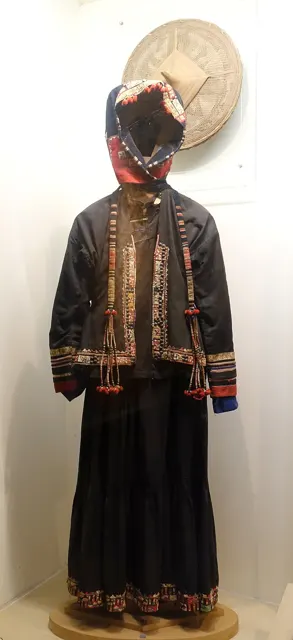
Dress: Women's skirts and blouses are decorated only with appliqué. The blouse comes in two layers. The outer one is open at the front with no buttons, its hem and opening edged with triangles, squares and lozenges of other colours, and the cuffs ringed with coloured bands. The short inner one fastens under the right arm. The skirt hem carries a band of cut squares and triangles.
Giáy (Nhắng)
Skilled terrace rice farmers. Women wear indigo trousers and a long five-panel jacket that fastens under the right arm, with their hair wound round the head and pink threads at the ends.
Food: Plain rice that is part-boiled and then steamed like sticky rice.
Dress: Women once wore pleated skirts like the Hmong. Today they wear indigo-black trousers with a band of red at the waist and a five-panel tunic slit at the sides, reaching below the hips and fastened under the right arm, with the hem and cuffs bordered in other colours. Men wear loose trousers and a jacket open at the front. Dress varies by area: in Hà Giang women wear a skirt and a long tunic close to the Nùng style, while in Lào Cai they wear trousers and a short tunic.
Hoa (ethnic Chinese)
Small communities of traders and farmers along the Chinese border. Old shophouses with tiled roofs, like those in Đồng Văn's old quarter, show Chinese influence.
Food: Rice, with noodle dishes.
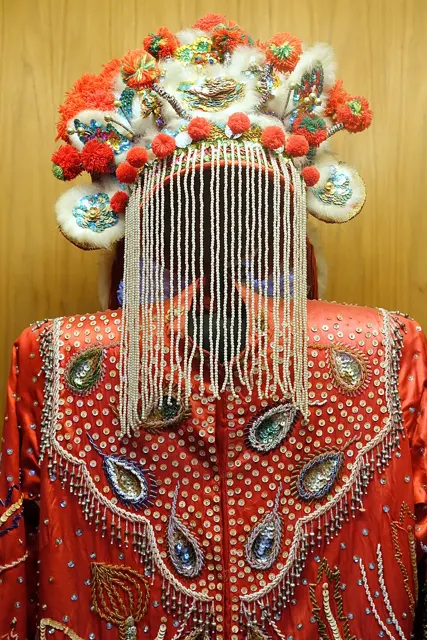
Dress: Traditional dress is now worn mainly by older people and at weddings and funerals. Women wear a high-collared tunic fastened at one side, or a long close-fitting sườn xám slit at the thigh. Girls favour pink, red and other strong colours. Men wear black or dark blue jackets with cloth buttons down one side and a stand-up collar. Women like bracelets of copper, gold, stone or jade, with earrings and necklaces. Men traditionally had gold-capped teeth as an ornament.
Military history and figures
Military history
- Lũng Cú flagpole. Tradition holds that a flagpole has stood here since Lý Thường Kiệt’s day, and that Quang Trung’s men also raised a flag. The present tower dates from 2002 and stands near the northernmost point of Vietnam. The frontier here was fixed by the Sino-French delimitation of 1887.
Linked figures
- Lý Thường Kiệt.
- Quang Trung.
Practical notes
- Second night at Đồng Văn, no luggage
- This track was drawn with a routing service and the road surface has not been checked. Ask locally the evening before.