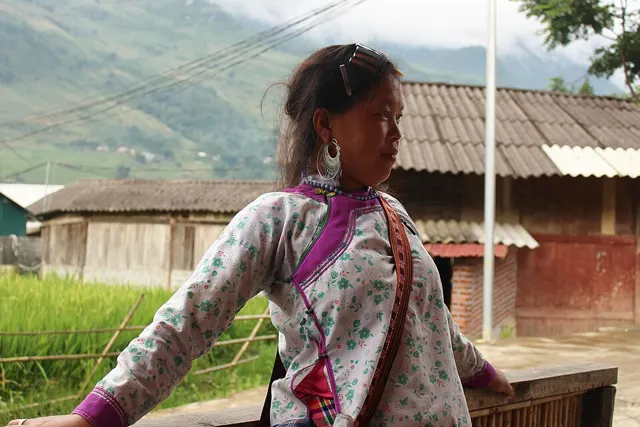
Skilled terrace rice farmers. Women wear indigo trousers and a long five-panel jacket that fastens under the right arm, with their hair wound round the head and pink threads at the ends. Mường Hum and Bản Xèo are Giáy villages, and so is part of Tả Van in the Mường Hoa valley.
Dress
Women once wore pleated skirts like the Hmong. Today they wear indigo-black trousers with a band of red at the waist and a five-panel tunic slit at the sides, reaching below the hips and fastened under the right arm, with the hem and cuffs bordered in other colours. Men wear loose trousers and a jacket open at the front. Dress varies by area: in Hà Giang women wear a skirt and a long tunic close to the Nùng style, while in Lào Cai they wear trousers and a short tunic.
Traditions and beliefs
The central altar holds three incense bowls: for the kitchen god, for heaven and earth, and for the ancestors. They keep the north-eastern calendar of Tết, Qingming and the Dragon Boat Festival. Their 'vươn' songs come in three kinds: songs over the wine tray, night songs and farewell songs.
Food and drink
Plain rice that is part-boiled and then steamed like sticky rice. The water it was boiled in is drunk. Festival cooking shows strong Chinese influence.