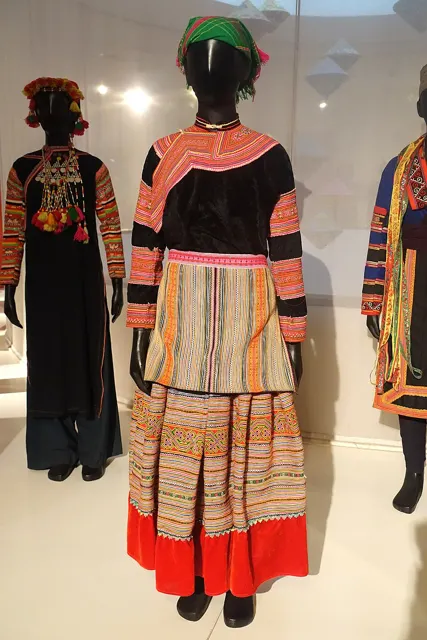
The people you'll see most in the high country. They make up about 72% of the Đồng Văn plateau and about half of Sa Pa, and Mường Lống is entirely Hmong. The sub-groups are named after their dress. The Black Hmong of Sa Pa wear indigo-dyed hemp decorated with beeswax batik. The Flower Hmong of Bắc Hà wear brilliant embroidered skirts. You'll also meet White, Green and Red Hmong.
Dress
The most colourful dress in the north, and different for each branch. White Hmong women grow hemp and weave linen, and wear white skirts with an open-fronted blouse embroidered on the sleeves and a panel at the back of the collar. Flower Hmong women, whom you'll see at Bắc Hà, wear indigo skirts embroidered or printed with beeswax batik, with appliqué and embroidery across the shoulders and chest. Black Hmong women around Sa Pa wear indigo skirts patterned with beeswax and an open-fronted blouse. Green Hmong women wear a tubular skirt, and once married wind their hair up with a horseshoe comb under a headscarf shaped like two horns. Decoration is mostly appliqué, with spirals, squares, lozenges and crosses as the common motifs.
Traditions and beliefs
Clan is everything: people of the same surname recognise each other through shared rituals, even from far apart, and may not marry. Inside the house there are separate sacred places for the ancestors, the house spirit, the door spirit and the kitchen spirit. The main altar is a sheet of gilded paper on the wall, renewed every New Year and daubed with chicken blood and feathers. Hmong New Year starts at the beginning of the 12th lunar month, a month before Tết, and is celebrated with ball-throwing, swings, spinning tops and the khèn bamboo pipes. The khèn is also played at funerals, while the leaf whistle and jaw harp are used for courtship. The Gầu Tào festival is held to pray for health and fertility. On the plateau, look for earth-walled houses and stone walls almost 2 m high around each homestead, and the Vương family mansion at Sà Phìn. Many rituals bar strangers from the house or the whole village.
Food and drink
Two meals a day, three at harvest. The staple is mèn mén, steamed ground maize eaten with a wooden spoon, or rice, with greens fried in lard and a soup. Thắng cố, a big pan of beef, goat or horse offal stewed together, is the market-day dish. Maize and rice wine are offered to guests, and filling a guest's bamboo water pipe for them is a mark of respect.
Where you meet them on the Northern Loop
Day 10, Day 12, Day 13, Day 14, Day 15, Day 17, Day 18, Day 19, Day 20, Day 21, Day 22, Day 23, Day 24, Day 25, Day 26, Day 27, Day 28, Day 33, Day 34