Setting
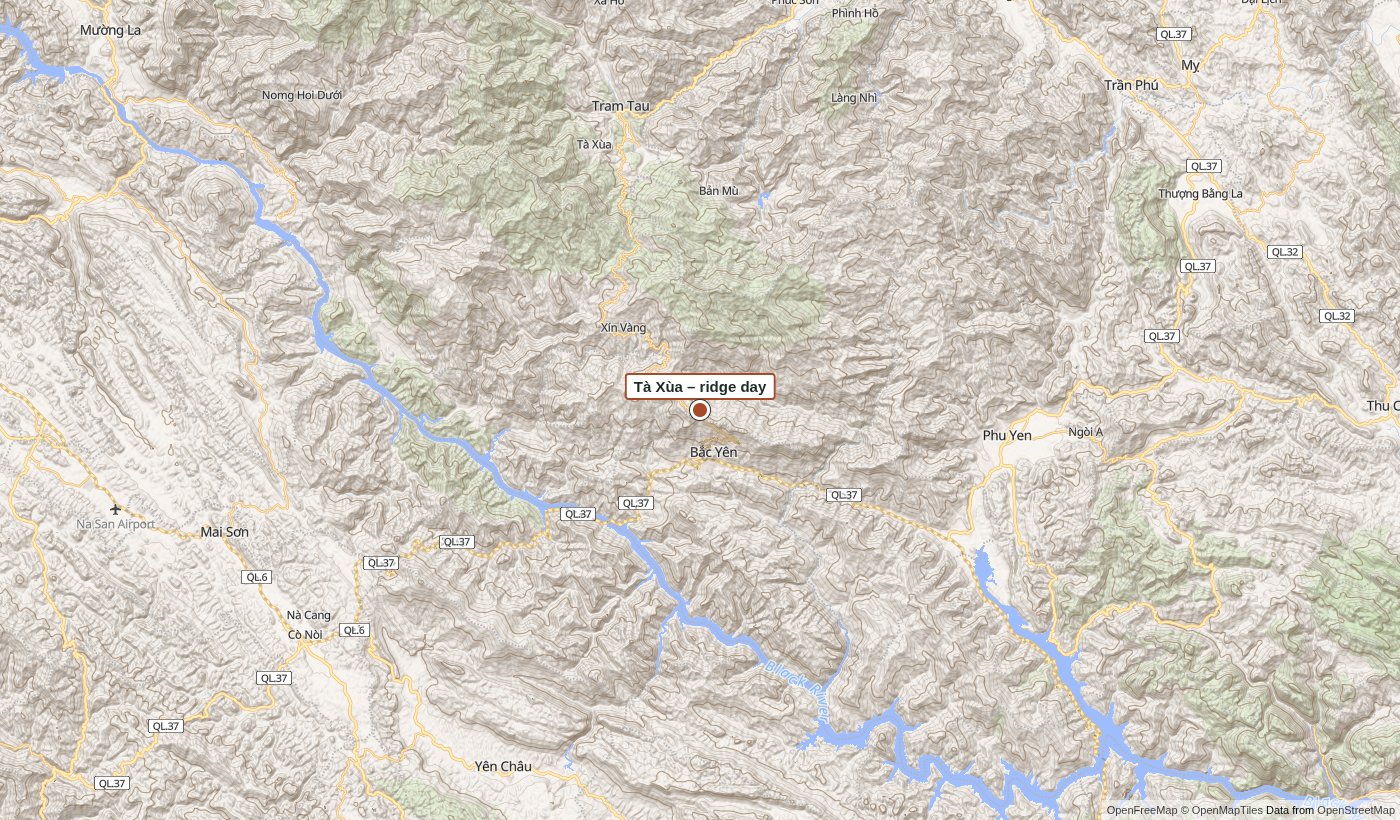
The Dinosaur Spine (Sống Khủng Long) at Háng Đồng is a narrow grass ridge with sheer drops on both sides, rising above the cloud.
Story
The ridge became famous only in the last decade, through photographers and backpackers.
People
Hmong.
Population and livelihoods
Tourism has changed Tà Xùa quickly. In 2025 the commune received about 130,000 visitors, worth about VND 75 billion (roughly €2.5 million). Many families have moved from farming to running homestays, cooking or supplying vegetables and meat to the guesthouses. Even so, farming is still the main living for most Hmong households here.
What makes it special
Go at dawn (5–7 am) for the cloud. At this time of year mornings are often clear above a valley full of cloud.
The peoples in more detail
Along the way: Hmong.
Hmong (H'Mông, Mèo, old name, now avoided)
The people you'll see most in the high country. They make up about 72% of the Đồng Văn plateau and about half of Sa Pa, and Mường Lống is entirely Hmong.
Food: Two meals a day, three at harvest.
Dress: The most colourful dress in the north, and different for each branch. White Hmong women grow hemp and weave linen, and wear white skirts with an open-fronted blouse embroidered on the sleeves and a panel at the back of the collar. Flower Hmong women, whom you'll see at Bắc Hà, wear indigo skirts embroidered or printed with beeswax batik, with appliqué and embroidery across the shoulders and chest. Black Hmong women around Sa Pa wear indigo skirts patterned with beeswax and an open-fronted blouse. Green Hmong women wear a tubular skirt, and once married wind their hair up with a horseshoe comb under a headscarf shaped like two horns. Decoration is mostly appliqué, with spirals, squares, lozenges and crosses as the common motifs.

Military history and figures
Military history
Nothing of note is recorded on the ridge itself. The Đà river crossings below were contested in the 1952 Northwest Campaign.
Linked figures
None of national note.
Practical notes
- Second night at Tà Xùa, no luggage. Dinosaur Spine at Háng Đồng: about 15 km each way (approximate, no GPX file). Go at dawn (5–7 am) for the clouds; walk the ridge or use a local motorbike taxi.