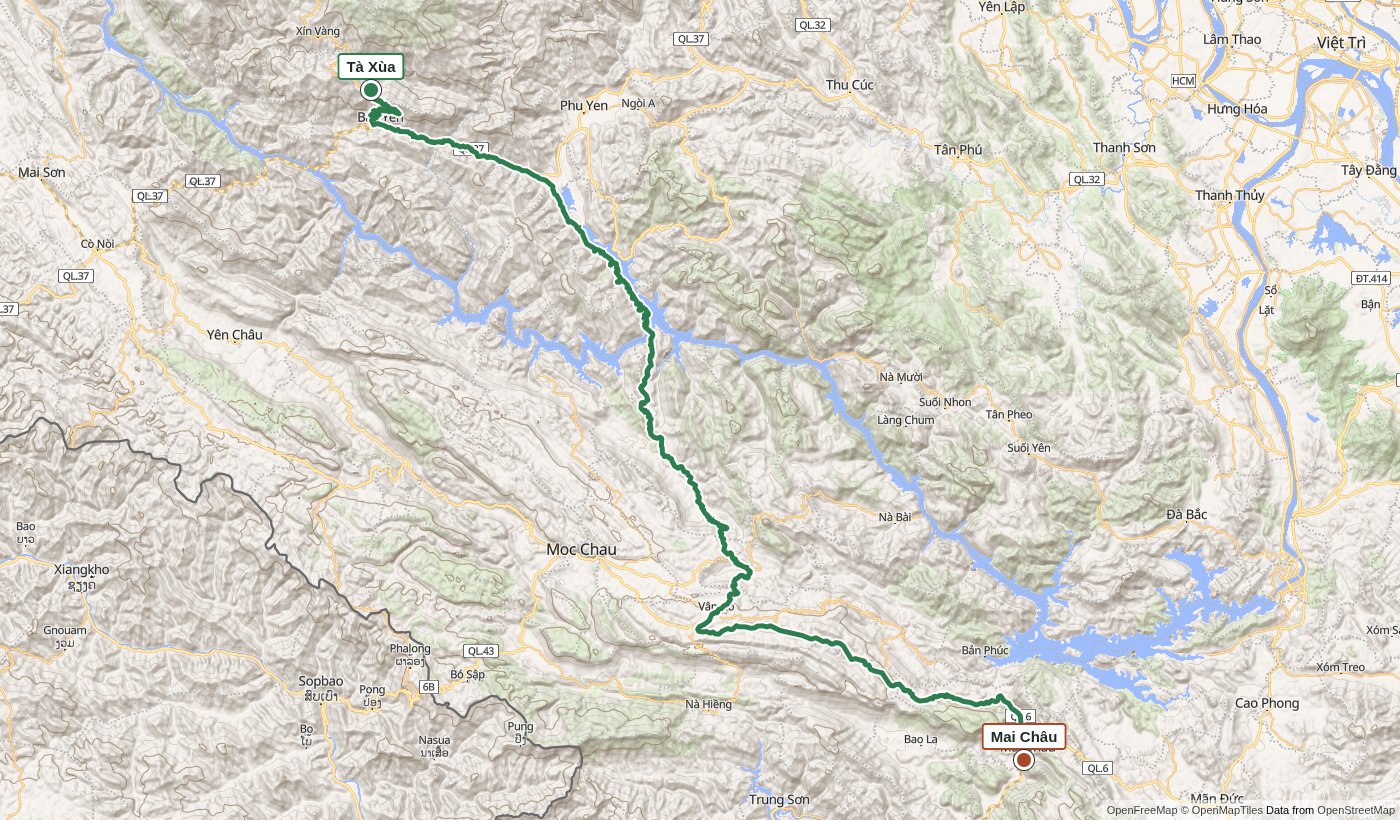
Setting
You come down from the ridge to the Mộc Châu plateau, then into the Mai Châu valley in Hòa Bình (now Phú Thọ).
Story
Mộc Châu’s tea hills were planted mainly between 1960 and 1965, when the state founded the Mộc Châu State Farm. The White Thái had grown tea here long before. The plateau is also Vietnam’s best-known dairy area.
People
Hmong, Thái, Mường and Dao (Mộc Châu, Vân Hồ).
Population and livelihoods
Mai Châu commune, formed in 2025, has a little over 19,000 people, most of them White Thái. Since 2025 it has been in Phú Thọ province, which absorbed Hòa Bình. Rice and tourism are the two pillars. Lác village has hosted visitors since 1993, and more than 300 looms are still weaving brocade. On the way, the Mộc Châu plateau is Vietnam’s oldest dairy area. The Mộc Châu dairy company works with more than 600 farming households and about 20,000 cows, and the plateau is also covered in tea.
What makes it special
The road passes from the Hmong uplands to the gentle White Thái valley of Mai Châu. You stay among stilt houses in Lác or Pom Coọng.
The peoples in more detail
Along the way: Hmong, Thái, Mường, Dao (Mộc Châu, Vân Hồ).
Hmong (H'Mông, Mèo, old name, now avoided)
The people you'll see most in the high country. They make up about 72% of the Đồng Văn plateau and about half of Sa Pa, and Mường Lống is entirely Hmong.
Food: Two meals a day, three at harvest.
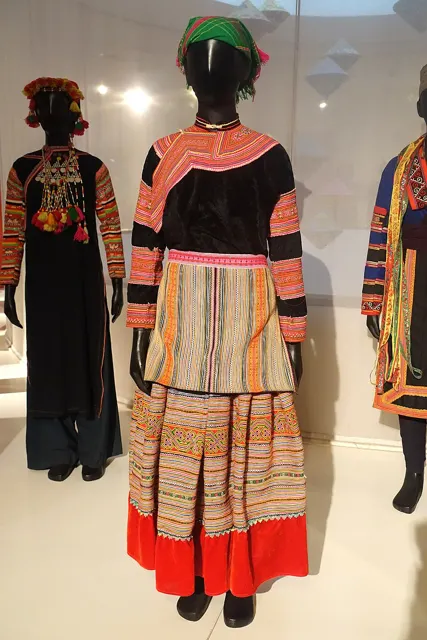
Dress: The most colourful dress in the north, and different for each branch. White Hmong women grow hemp and weave linen, and wear white skirts with an open-fronted blouse embroidered on the sleeves and a panel at the back of the collar. Flower Hmong women, whom you'll see at Bắc Hà, wear indigo skirts embroidered or printed with beeswax batik, with appliqué and embroidery across the shoulders and chest. Black Hmong women around Sa Pa wear indigo skirts patterned with beeswax and an open-fronted blouse. Green Hmong women wear a tubular skirt, and once married wind their hair up with a horseshoe comb under a headscarf shaped like two horns. Decoration is mostly appliqué, with spirals, squares, lozenges and crosses as the common motifs.
Thái (Tai Dam, Tai Don)
This is the people of the Days 16–24 valleys. Black Thái live around Sơn La and Điện Biên, and White Thái around Mai Châu.
Food: Sticky rice steamed in a wooden steamer is the traditional staple, though plain rice is now the everyday grain.
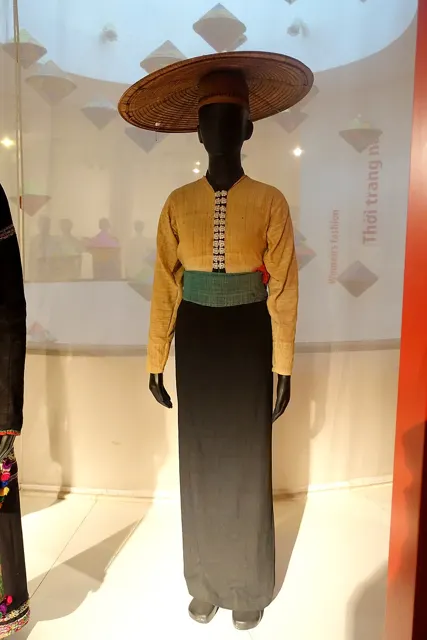
Dress: Thái women wear a short, close-fitting blouse in many colours, fastened down the front with silver buttons shaped like butterflies, spiders or cicadas. With it go a dark tubular skirt, a green silk sash at the waist and a silver chatelaine at the hip. For festivals they add a long black tunic. Black Thái women are known for the khăn piêu headscarf, embroidered in bright colours.
Mường
The closest relatives of the Kinh, sharing the same root language. Mai Châu is a mix of Thái and Mường, and Bá Thước is one of the old Mường heartlands.
Food: Steaming is the signature technique: sticky rice, plain rice, greens and fish are all steamed.
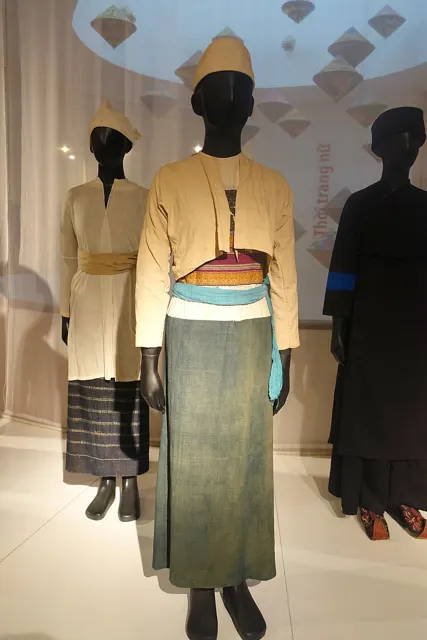
Dress: Mường women's dress is elegant and modest: a plain white rectangular headscarf, a very short blouse, usually white and open at the chest, a bib and an ankle-length skirt. The skirt's waistband is famous for its finely woven patterns. Jewellery includes bracelets, beads and a silver chatelaine of two or four chains hung with a peach-shaped betel box and silver-capped tiger or bear claws.
Dao (Yao, Mien)
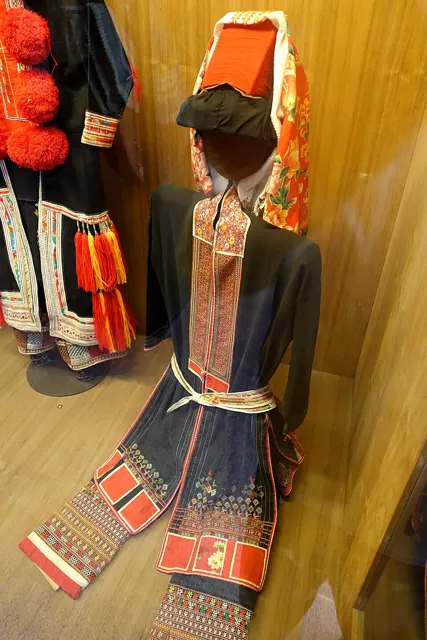
A large group with many branches, each with its own dress. In Bình Liêu you'll see Dao Thanh Y and Dao Thanh Phán, around Ba Bể the Dao live on the hillsides, at Bắc Hà market Black Dao come in, and in Sa Pa and Hoàng Su Phì there are Red Dao, with red pom-pom headdresses.
Food: Two main meals a day, of rice or, in some places, maize or rice porridge.
Dress: Dress varies more than in any other group, and each branch ties its headscarf in its own way. Red Dao women wind their hair up under the headscarf on top of the head. Their tunic has a brightly embroidered collar, and the bib carries eight-petalled flowers worked in silver. Women embroider from memory rather than from a drawn pattern, stitching on the back of the cloth so the design stands out on the front. They also print patterns in hot beeswax before dyeing, which leaves pale blue motifs on the indigo. Dao silversmiths make the neck rings, bracelets, anklets, earrings and betel boxes.
Military history and figures
Military history
In the 1952 Northwest Campaign, Việt Minh forces crossed the Đà river (7–22 November) and broke the French screen on the Mộc Châu plateau. The fall of Mộc Châu opened Route 41 (now QL6) and forced the French back on Nà Sản. Mai Châu and the Hòa Bình corridor saw fighting in the Hòa Bình campaign of the previous winter.
Linked figures
Võ Nguyên Giáp.
Practical notes
- Rejoins the Sơn La–Mai Châu road east of Mộc Châu.
- The new part of this track, as far as QL6, was drawn with a routing service and the road surface has not been checked. Ask locally the evening before.