Setting
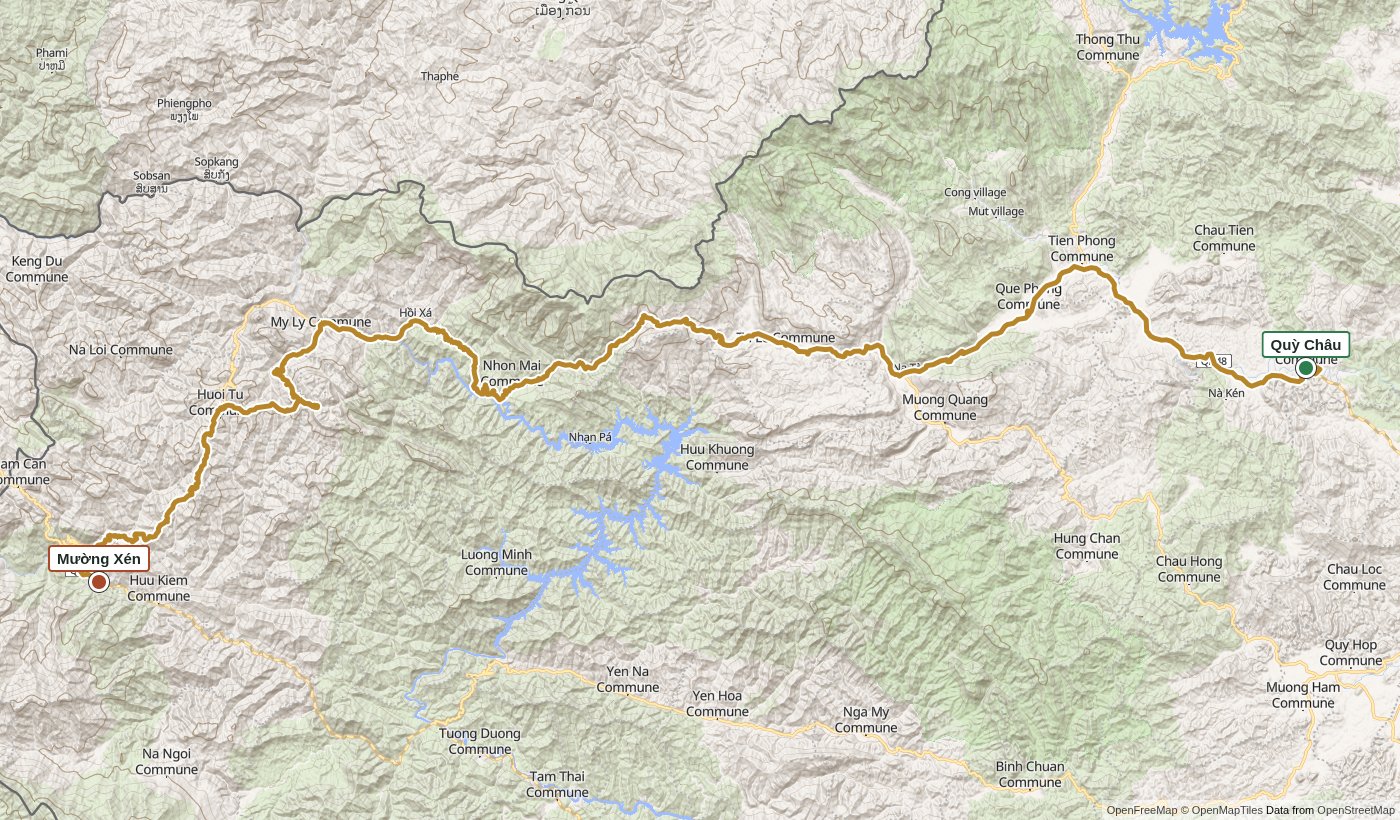
This is the most remote long day of the southern half. The road runs up through Quế Phong and along the Lao border to Mỹ Lý, a border commune of 211 km² with only about 5,900 people. It has the longest stretch of Lao frontier in Nghệ An, 43.5 km, and lies at the head of the Bản Vẽ reservoir on the Nậm Nơn river. You then climb to Nậm Cắn and come down to Mường Xén.
Story
Mường Xén is the centre of the former Kỳ Sơn district, which covers 2,095 km² of mountain along the Lao border. Mỹ Lý was one of the few communes left unmerged in 2025 because of its size and its frontier position. Until recently, reaching it from the river meant a whole day by dugout canoe.
People
Thái, Khơ Mú and Hmong.
Population and livelihoods
The former Kỳ Sơn district, centred on Mường Xén, had about 85,000 people at the end of 2024. It is one of the poorest districts in the country: almost half of households are poor or near-poor. Most families grow upland rice and maize and raise livestock. About 17,000 young people regularly leave to work in factories elsewhere in Vietnam or abroad. Their wages sent home are now one of the district’s main incomes. The Nậm Cắn border crossing into Laos brings some trade.
What makes it special
Few foreigners ever ride this border road.
The peoples in more detail
Along the way: Thái, Khơ Mú, Hmong.
Thái (Tai Dam, Tai Don)
This is the people of the Days 16–24 valleys. Black Thái live around Sơn La and Điện Biên, and White Thái around Mai Châu.
Food: Sticky rice steamed in a wooden steamer is the traditional staple, though plain rice is now the everyday grain.
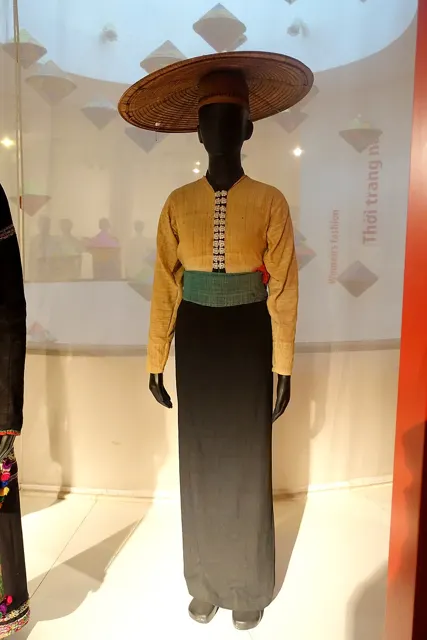
Dress: Thái women wear a short, close-fitting blouse in many colours, fastened down the front with silver buttons shaped like butterflies, spiders or cicadas. With it go a dark tubular skirt, a green silk sash at the waist and a silver chatelaine at the hip. For festivals they add a long black tunic. Black Thái women are known for the khăn piêu headscarf, embroidered in bright colours.
Khơ Mú (Khmu)
Upland farmers known for their fine basketry in bamboo and rattan. They are about 3% of Điện Biên and the largest group in Kỳ Sơn, at about 36%.
Food: Steamed sticky rice or steamed maize, often bulked out with cassava.
Dress: The Khơ Mú dress much like the Thái, except that women sew rows of silver coins and shells down the front of the blouse. Most Khơ Mú, especially men, now dress like the Kinh.
Hmong (H'Mông, Mèo, old name, now avoided)
The people you'll see most in the high country. They make up about 72% of the Đồng Văn plateau and about half of Sa Pa, and Mường Lống is entirely Hmong.
Food: Two meals a day, three at harvest.
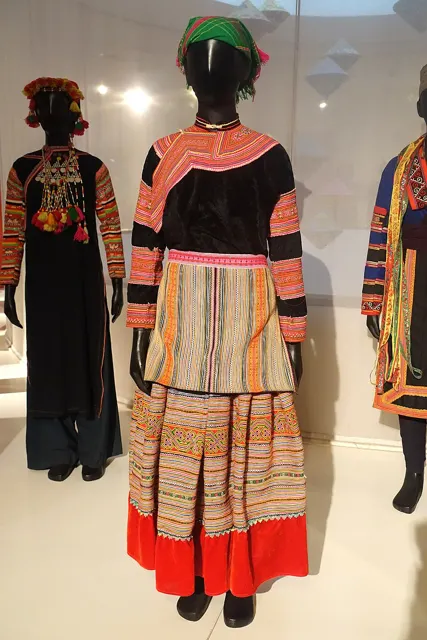
Dress: The most colourful dress in the north, and different for each branch. White Hmong women grow hemp and weave linen, and wear white skirts with an open-fronted blouse embroidered on the sleeves and a panel at the back of the collar. Flower Hmong women, whom you'll see at Bắc Hà, wear indigo skirts embroidered or printed with beeswax batik, with appliqué and embroidery across the shoulders and chest. Black Hmong women around Sa Pa wear indigo skirts patterned with beeswax and an open-fronted blouse. Green Hmong women wear a tubular skirt, and once married wind their hair up with a horseshoe comb under a headscarf shaped like two horns. Decoration is mostly appliqué, with spirals, squares, lozenges and crosses as the common motifs.
Military history and figures
This area is covered on Day 32.