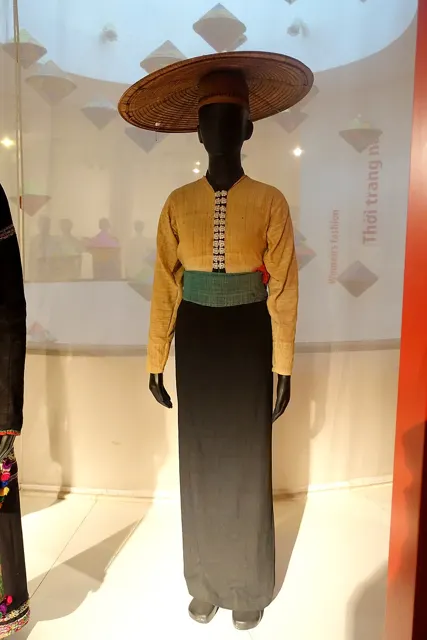
This is the people of the Days 22–36 valleys. Black Thái live around Sơn La and Điện Biên, and White Thái around Mai Châu. Thái are about 36% of Điện Biên and over 90% of Quế Phong. They are masters of valley irrigation, summed up in the saying 'mương, phai, lái, lịn': channel, weir, conduit, flume. Women wear short fitted blouses with silver butterfly buttons and a dark tube skirt.
Dress
Thái women wear a short, close-fitting blouse in many colours, fastened down the front with silver buttons shaped like butterflies, spiders or cicadas. With it go a dark tubular skirt, a green silk sash at the waist and a silver chatelaine at the hip. For festivals they add a long black tunic. Black Thái women are known for the khăn piêu headscarf, embroidered in bright colours.
Traditions and beliefs
Historically a groom lived with his wife's family for 8 to 12 years before taking her home. After the first wedding rite, a Black Thái wife puts her hair up in a topknot (tằng cẩu) that marks her as married. Black Thái honour their ancestors in the 7th and 8th lunar months, while White Thái keep the lunar Tết. The xòe circle dance is on UNESCO's intangible heritage list. You'll also see the sạp bamboo-pole dance. In Điện Biên the Ban (bauhinia) Flower Festival is usually held in mid-March.
Food and drink
Sticky rice steamed in a wooden steamer is the traditional staple, though plain rice is now the everyday grain. Every tray has a chéo, a pounded relish of chilli, salt, garlic and herbs. Meat from buffalo, cattle or goats comes with nặm pịa, a bitter sauce made from the contents of the small intestine. Signature dishes are pa pỉnh tộp, folded grilled stream fish seasoned with mắc khén pepper, and five-colour sticky rice, smoked buffalo and river moss.
Where you meet them on the Northern Loop
Day 22, Day 23, Day 24, Day 25, Day 26, Day 28, Day 29, Day 30, Day 31, Day 32, Day 33, Day 34, Day 35, Day 36