Setting
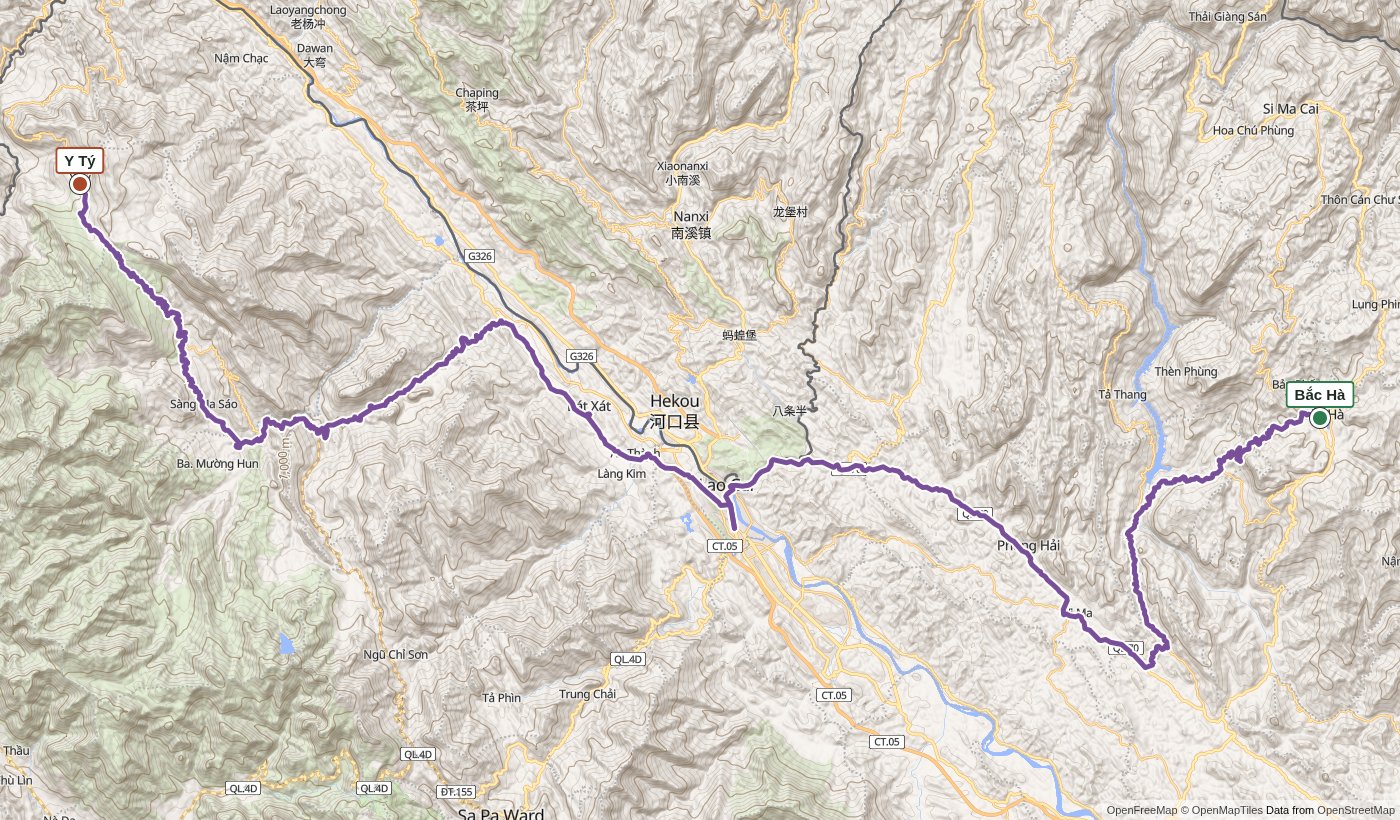
The road comes down to the Red River at Lào Cai city on the Chinese border, then climbs through Bát Xát to Y Tý. Y Tý is a commune at around 2,000 m below peaks such as Lảo Thẩn (2,860 m).
Story
The Red River enters Vietnam at Lào Cai and the city faces Hekou in Yunnan across the Nậm Thi. It has been a trade gateway for centuries. Lào Cai was also hit hard in the 1979 war. Y Tý is known for “cloud hunting”, seas of cloud over the terraced valleys.
People
Flower Hmong, Phù Lá, Giáy and Dao, then the Black Hà Nhì at Y Tý. They live in earth-walled “mushroom” houses with thatched roofs.
Population and livelihoods
Y Tý commune, enlarged in 2025, has about 10,300 people. Hà Nhì make up most of the population, with Hmong, Dao and Giáy. At about 2,000 m it is too high for much rice, so the cash crop is black cardamom (thảo quả), grown under the forest canopy. Local people call it the plant that pays best, and it has lifted many families out of poverty. Medicinal plants, temperate fruit and a little homestay tourism are newer incomes.
What makes it special
Y Tý is one of the remotest settlements in the north, with Hà Nhì culture still very much alive.
The peoples in more detail
Along the way: Flower Hmong, Phù Lá, Giáy, Dao, Hmong, Black Hà Nhì at Y Tý.
Hmong (H'Mông, Mèo, old name, now avoided)
The people you'll see most in the high country. They make up about 72% of the Đồng Văn plateau and about half of Sa Pa, and Mường Lống is entirely Hmong.
Food: Two meals a day, three at harvest.
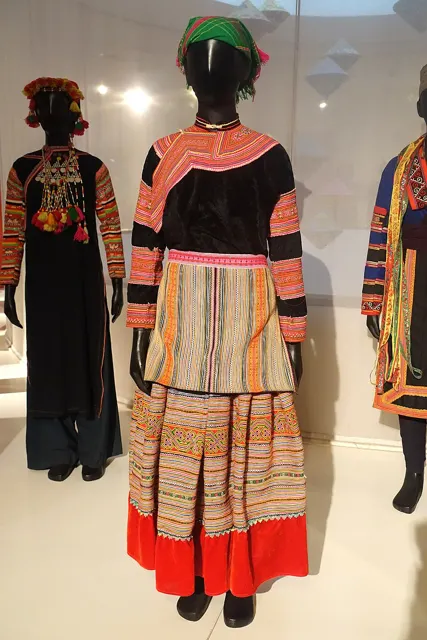
Dress: The most colourful dress in the north, and different for each branch. White Hmong women grow hemp and weave linen, and wear white skirts with an open-fronted blouse embroidered on the sleeves and a panel at the back of the collar. Flower Hmong women, whom you'll see at Bắc Hà, wear indigo skirts embroidered or printed with beeswax batik, with appliqué and embroidery across the shoulders and chest. Black Hmong women around Sa Pa wear indigo skirts patterned with beeswax and an open-fronted blouse. Green Hmong women wear a tubular skirt, and once married wind their hair up with a horseshoe comb under a headscarf shaped like two horns. Decoration is mostly appliqué, with spirals, squares, lozenges and crosses as the common motifs.
Phù Lá (including the Xa Phó)
Hill farmers known for their patterned rattan and bamboo baskets, who come in to the Bắc Hà and Cán Cấu markets. The Xa Phó of Nậm Sài, a Phù Lá sub-group, are Sa Pa's smallest community.
Food: Rice is pounded by hand every day and eaten in two meals, early morning and evening.
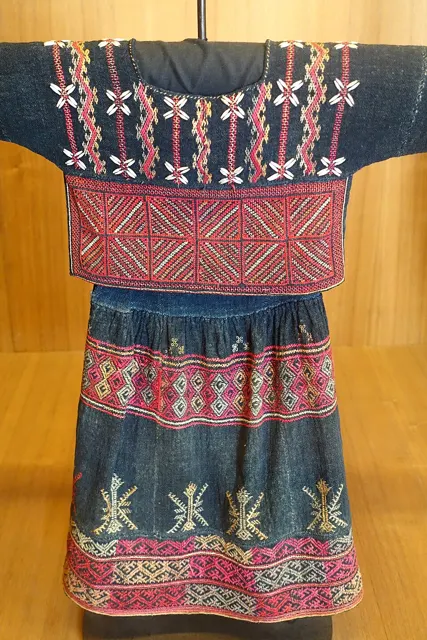
Dress: Women's dress differs between branches. Phù Lá Lão women wear a skirt and a short square-necked pullover blouse, embroidered and beaded, with a belt sewn with mountain snail shells. Other branches wear trousers with a long open-fronted tunic or a short tunic fastened at the side. The Phù Lá Lão man's jacket is unusual, with many beads sewn on the back.
Giáy (Nhắng)
Skilled terrace rice farmers. Women wear indigo trousers and a long five-panel jacket that fastens under the right arm, with their hair wound round the head and pink threads at the ends.
Food: Plain rice that is part-boiled and then steamed like sticky rice.
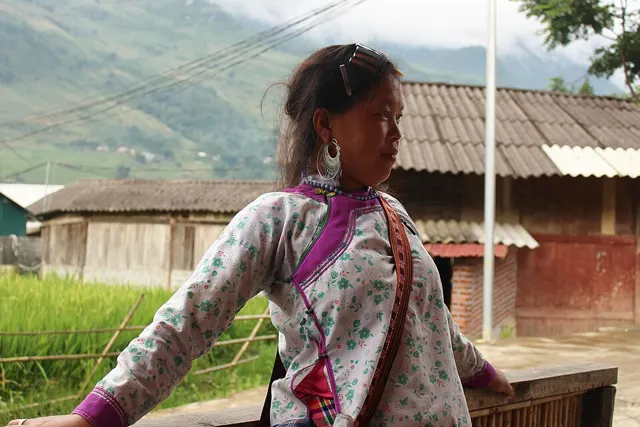
Dress: Women once wore pleated skirts like the Hmong. Today they wear indigo-black trousers with a band of red at the waist and a five-panel tunic slit at the sides, reaching below the hips and fastened under the right arm, with the hem and cuffs bordered in other colours. Men wear loose trousers and a jacket open at the front. Dress varies by area: in Hà Giang women wear a skirt and a long tunic close to the Nùng style, while in Lào Cai they wear trousers and a short tunic.
Dao (Yao, Mien)
A large group with many branches, each with its own dress. In Bình Liêu you'll see Dao Thanh Y and Dao Thanh Phán, around Ba Bể the Dao live on the hillsides, at Bắc Hà market Black Dao come in, and in Sa Pa and Hoàng Su Phì there are Red Dao, with red pom-pom headdresses.
Food: Two main meals a day, of rice or, in some places, maize or rice porridge.
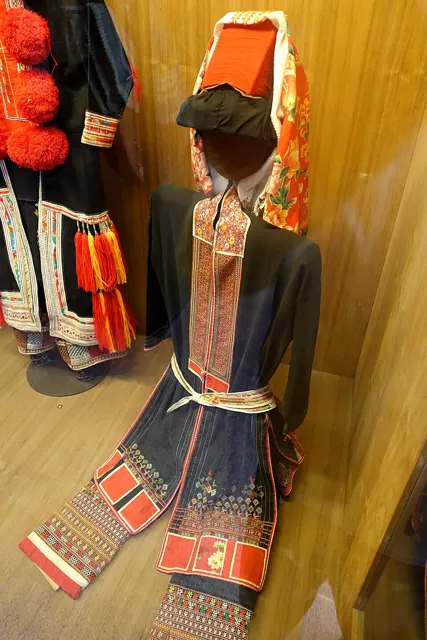
Dress: Dress varies more than in any other group, and each branch ties its headscarf in its own way. Red Dao women wind their hair up under the headscarf on top of the head. Their tunic has a brightly embroidered collar, and the bib carries eight-petalled flowers worked in silver. Women embroider from memory rather than from a drawn pattern, stitching on the back of the cloth so the design stands out on the front. They also print patterns in hot beeswax before dyeing, which leaves pale blue motifs on the indigo. Dao silversmiths make the neck rings, bracelets, anklets, earrings and betel boxes.
Hà Nhì (Hani)
In Lào Cai, the Black Hà Nhì live only in Bát Xát, where they make up about 6% of the population. They build terraces with clever irrigation channels on very steep slopes.
Food: Both sticky and plain rice, with food from hunting, fishing and foraging.
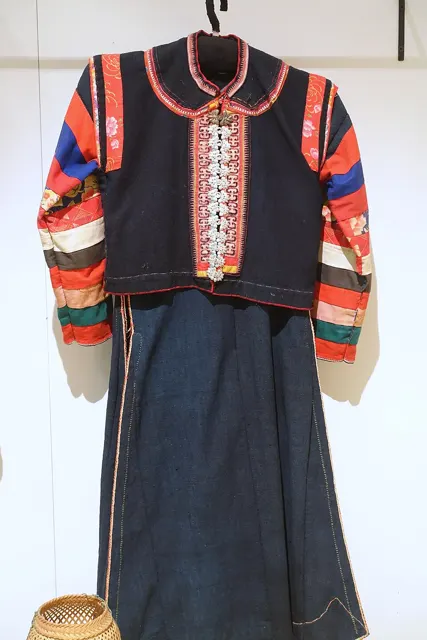
Dress: The Black Hà Nhì of Y Tý and Bát Xát dress in indigo-black, blue and white. Women wear a long four-panel tunic slit at the sides and a long black bib that covers the front from neck to hem. Their tunics are edged with curving lines like waves and clouds and carry flowers worked in silver. The headdress is the highlight: a hairpiece plaited from horse hair runs across the forehead. Unmarried girls wear bright hats of coloured thread and beads, and married women a square headscarf. Men wear black with a blue collar and a turban.
Military history and figures
Military history
- Black Flags. From 1868 Lào Cai was the base of Liu Yongfu’s Black Flag Army. These were Chinese irregulars who controlled the Red River trade and later fought the French for the Huế court, killing Francis Garnier (1873) and Henri Rivière (1883) near Hà Nội.
- 1979. Lào Cai was one of the main axes of the Chinese attack. The town and the bridges were heavily damaged.
Linked figures
- Liu Yongfu (Lưu Vĩnh Phúc, 1837–1917).
Practical notes
- Hà Nhì villages.
- The new part of this track, from Bát Xát onwards, was drawn with a routing service and the road surface has not been checked. Ask locally the evening before.