Setting
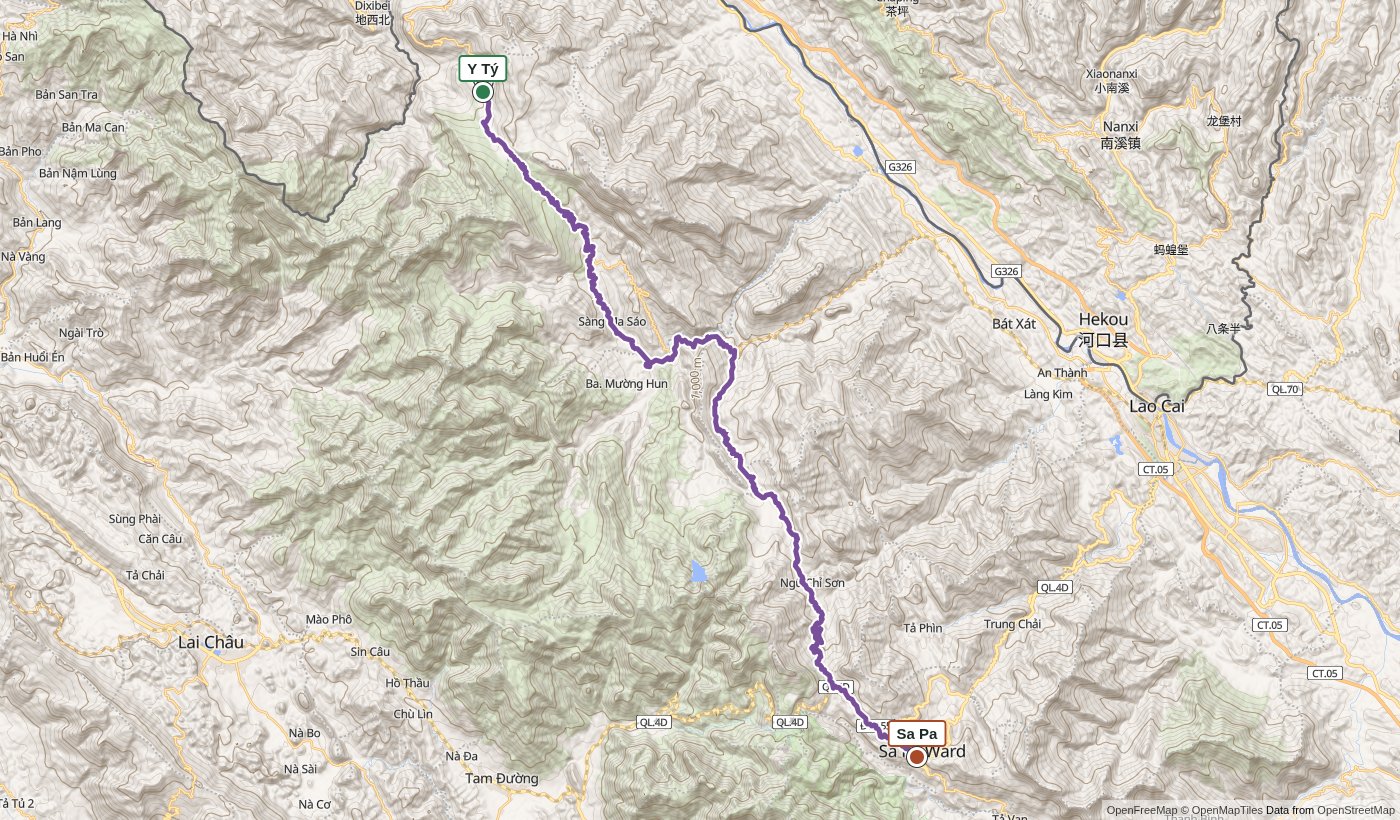
This is a short day. You come down from Y Tý past Bản Xèo and the Mường Hum valley, then climb to Sa Pa at about 1,500 m in the Hoàng Liên Sơn range.
Story
France took control of Tonkin after the Sino-French War of 1885, and the Lào Cai region came under military administration. Sa Pa was developed as a hill station for colonial officials from the early 20th century. The stone church is a reminder of that time.
People
Black Hà Nhì, Hmong, Dao and Giáy (Bản Xèo, Mường Hum).
Population and livelihoods
Sa Pa town had about 71,000 people in 2022. It received about 4.6 million visitors in 2024, earning about VND 15,500 billion (roughly €500 million). Tourism and services make up more than half of all income here. Since 2025 Lào Cai and Yên Bái have formed one province of about 1.78 million people. Away from tourism, Lào Cai is a mining province. It has Vietnam’s largest copper mine at Sin Quyền near Bát Xát, with a smelter producing more than 11,000 tonnes of copper a year, and a century-old apatite (phosphate) mine at Cam Đường.
What makes it special
You move from one of the remotest communes to the north’s best-known resort in a couple of hours. It is a good moment to talk about how tourism has changed the Hmong and Dao villages around Sa Pa.
The peoples in more detail
Along the way: Black Hà Nhì, Hmong, Dao, Giáy (Bản Xèo, Mường Hum).
Hà Nhì (Hani)
In Lào Cai, the Black Hà Nhì live only in Bát Xát, where they make up about 6% of the population. They build terraces with clever irrigation channels on very steep slopes.
Food: Both sticky and plain rice, with food from hunting, fishing and foraging.
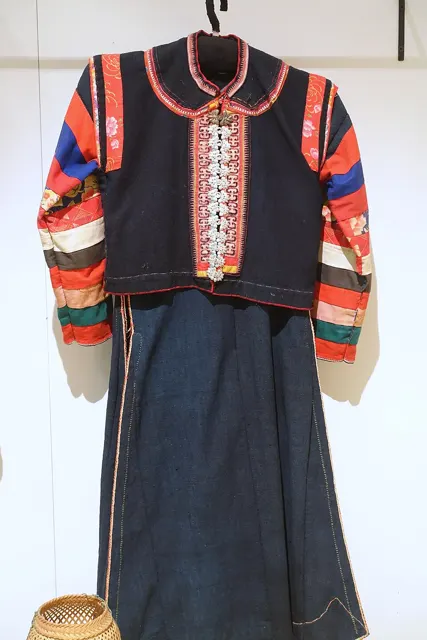
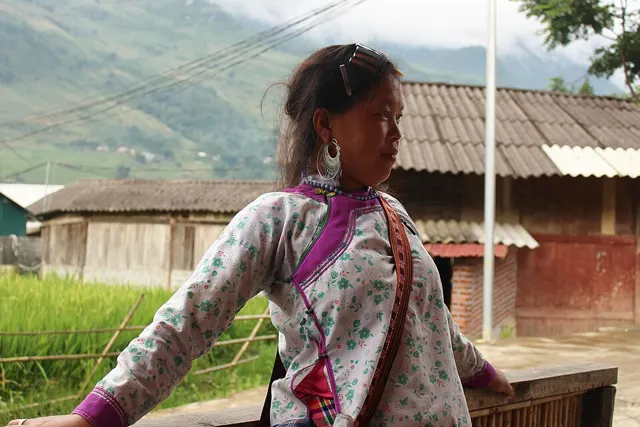
Dress: The Black Hà Nhì of Y Tý and Bát Xát dress in indigo-black, blue and white. Women wear a long four-panel tunic slit at the sides and a long black bib that covers the front from neck to hem. Their tunics are edged with curving lines like waves and clouds and carry flowers worked in silver. The headdress is the highlight: a hairpiece plaited from horse hair runs across the forehead. Unmarried girls wear bright hats of coloured thread and beads, and married women a square headscarf. Men wear black with a blue collar and a turban.
Hmong (H'Mông, Mèo, old name, now avoided)
The people you'll see most in the high country. They make up about 72% of the Đồng Văn plateau and about half of Sa Pa, and Mường Lống is entirely Hmong.
Food: Two meals a day, three at harvest.
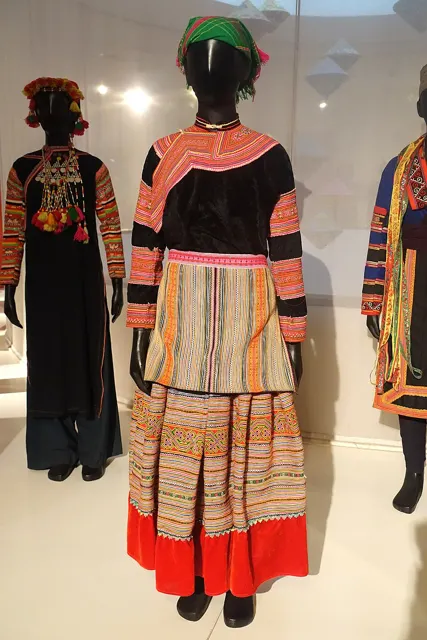
Dress: The most colourful dress in the north, and different for each branch. White Hmong women grow hemp and weave linen, and wear white skirts with an open-fronted blouse embroidered on the sleeves and a panel at the back of the collar. Flower Hmong women, whom you'll see at Bắc Hà, wear indigo skirts embroidered or printed with beeswax batik, with appliqué and embroidery across the shoulders and chest. Black Hmong women around Sa Pa wear indigo skirts patterned with beeswax and an open-fronted blouse. Green Hmong women wear a tubular skirt, and once married wind their hair up with a horseshoe comb under a headscarf shaped like two horns. Decoration is mostly appliqué, with spirals, squares, lozenges and crosses as the common motifs.
Dao (Yao, Mien)
A large group with many branches, each with its own dress. In Bình Liêu you'll see Dao Thanh Y and Dao Thanh Phán, around Ba Bể the Dao live on the hillsides, at Bắc Hà market Black Dao come in, and in Sa Pa and Hoàng Su Phì there are Red Dao, with red pom-pom headdresses.
Food: Two main meals a day, of rice or, in some places, maize or rice porridge.
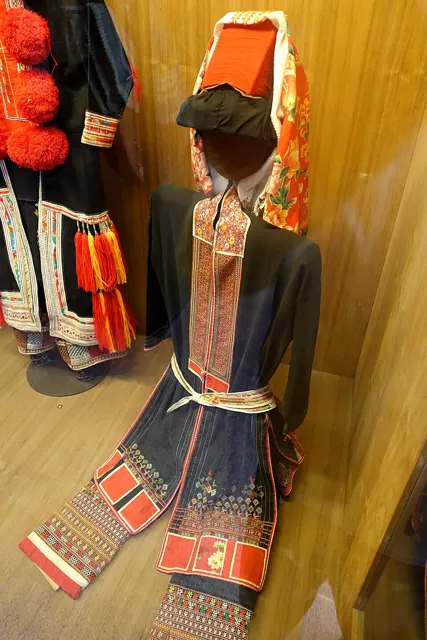
Dress: Dress varies more than in any other group, and each branch ties its headscarf in its own way. Red Dao women wind their hair up under the headscarf on top of the head. Their tunic has a brightly embroidered collar, and the bib carries eight-petalled flowers worked in silver. Women embroider from memory rather than from a drawn pattern, stitching on the back of the cloth so the design stands out on the front. They also print patterns in hot beeswax before dyeing, which leaves pale blue motifs on the indigo. Dao silversmiths make the neck rings, bracelets, anklets, earrings and betel boxes.
Giáy (Nhắng)
Skilled terrace rice farmers. Women wear indigo trousers and a long five-panel jacket that fastens under the right arm, with their hair wound round the head and pink threads at the ends.
Food: Plain rice that is part-boiled and then steamed like sticky rice.
Dress: Women once wore pleated skirts like the Hmong. Today they wear indigo-black trousers with a band of red at the waist and a five-panel tunic slit at the sides, reaching below the hips and fastened under the right arm, with the hem and cuffs bordered in other colours. Men wear loose trousers and a jacket open at the front. Dress varies by area: in Hà Giang women wear a skirt and a long tunic close to the Nùng style, while in Lào Cai they wear trousers and a short tunic.
Military history and figures
Military history
Bát Xát district, on the Red River border, was attacked in 1979. Sa Pa itself grew up as a French hill station and military sanatorium from the early 20th century.
Linked figures
None of national note.
Practical notes
- Short day after the Y Tý night. Mường Hum is a short detour off this road.
- The new part of this track, as far as Bản Xèo, was drawn with a routing service and the road surface has not been checked. Ask locally the evening before.