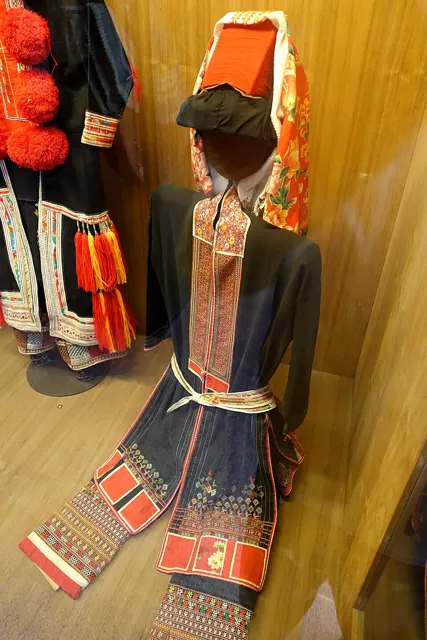
A large group with many branches, each with its own dress. In Bình Liêu you'll see Dao Thanh Y and Dao Thanh Phán, around Ba Bể the Dao live on the hillsides, at Bắc Hà market Black Dao come in, and in Sa Pa and Hoàng Su Phì there are Red Dao, with red pom-pom headdresses.
Dress
Dress varies more than in any other group, and each branch ties its headscarf in its own way. Red Dao women wind their hair up under the headscarf on top of the head. Their tunic has a brightly embroidered collar, and the bib carries eight-petalled flowers worked in silver. Women embroider from memory rather than from a drawn pattern, stitching on the back of the cloth so the design stands out on the front. They also print patterns in hot beeswax before dyeing, which leaves pale blue motifs on the indigo. Dao silversmiths make the neck rings, bracelets, anklets, earrings and betel boxes.
Traditions and beliefs
Their religion combines spirit beliefs and farming rites with strong Taoist influence. Bàn Vương, the legendary first ancestor, is worshipped alongside each family's own ancestors. Every Dao man must go through cấp sắc, a Taoist-style initiation that also marks him as an adult. Weddings begin with checking the couple's birth years and reading chicken bones for compatibility. Then come sung exchanges between the two families, and the bride is carried out of her home and steps over a pair of scissors blessed by the shaman. The tale of the flood and the gourd is a favourite story.
Food and drink
Two main meals a day, of rice or, in some places, maize or rice porridge. Families raise pigs, chickens, buffalo and cattle, with goats and horses higher up. They like boiled meat, smoked and dried meat, meat cured sour, and soup made with sour bamboo shoots. The Red Dao herbal bath, in a wooden tub of steeped forest leaves, is now offered to visitors around Sa Pa.
Where you meet them on the Northern Loop
Day 5, Day 6, Day 7, Day 9, Day 10, Day 11, Day 12, Day 13, Day 15, Day 16, Day 17, Day 18, Day 19, Day 20, Day 21, Day 22, Day 23, Day 28