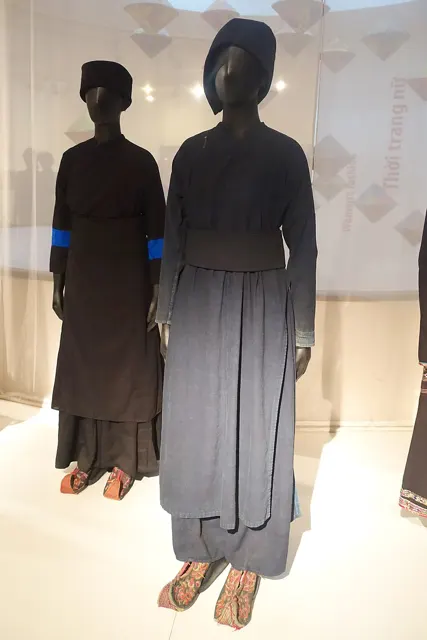
Valley rice farmers who live in timber stilt houses and wear plain indigo-dyed clothes. They are the majority in Bình Liêu and have lived around Ba Bể for about 2,000 years; Pác Ngòi is a Tày village. Their Then ritual singing, accompanied by the long-necked tính lute, is on UNESCO's intangible heritage list.
Dress
Plain clothes of home-woven cotton, dyed indigo and almost never embroidered. Women wear a short blouse under a long tunic, with a skirt or trousers. The local sub-groups differ in detail: the Ngạn wear a slightly shorter tunic, the Phén wear brown, the Thu Lao wind their headscarf into a point on top of the head, and the Thổ dress like the Thái of Mai Châu.
Traditions and beliefs
Ancestors come first, alongside the earth god, the kitchen god and the goddess of childbirth. The big festivals are Tết and the full moon of the seventh lunar month, when wandering souls are fed. There's also a festival to call back the souls of buffalo and cattle after transplanting, on the 6th day of the 6th lunar month, and a new-rice festival before harvest. Lượn love songs are sung at the Lồng Tồng spring festival, at weddings and when guests arrive. Traditionally a bride stayed with her own parents until her first child was nearly due.
Food and drink
Sticky rice was once the staple, and most homes still have a steamer for it. Tết brings a whole range of cakes: bánh chưng, bánh gio and bánh khảo, a cake stuffed with ants' eggs, and cốm, made from young sticky rice that is toasted and pounded. Around Ba Bể, expect lake fish and bamboo-tube rice in the homestays.
Where you meet them on the Northern Loop
Day 5, Day 6, Day 7, Day 8, Day 9, Day 10, Day 11, Day 12, Day 15, Day 16, Day 20, Day 21